


The creator economy is still being described as a talent business. That description is increasingly incomplete.
The most active buyers are not only looking for access to creators. They are looking for businesses that can help brands participate in culture, activate fandom, and produce measurable commercial outcomes at scale.
That matters for founders building agencies, management companies, creator platforms, and talent businesses. A roster can create attention. A repeatable operating model is what creates enterprise value.
The recent transaction pattern
Our latest review of June and July public announcements surfaced 13 supported transactions across creator media, commerce, software, music, and agencies.
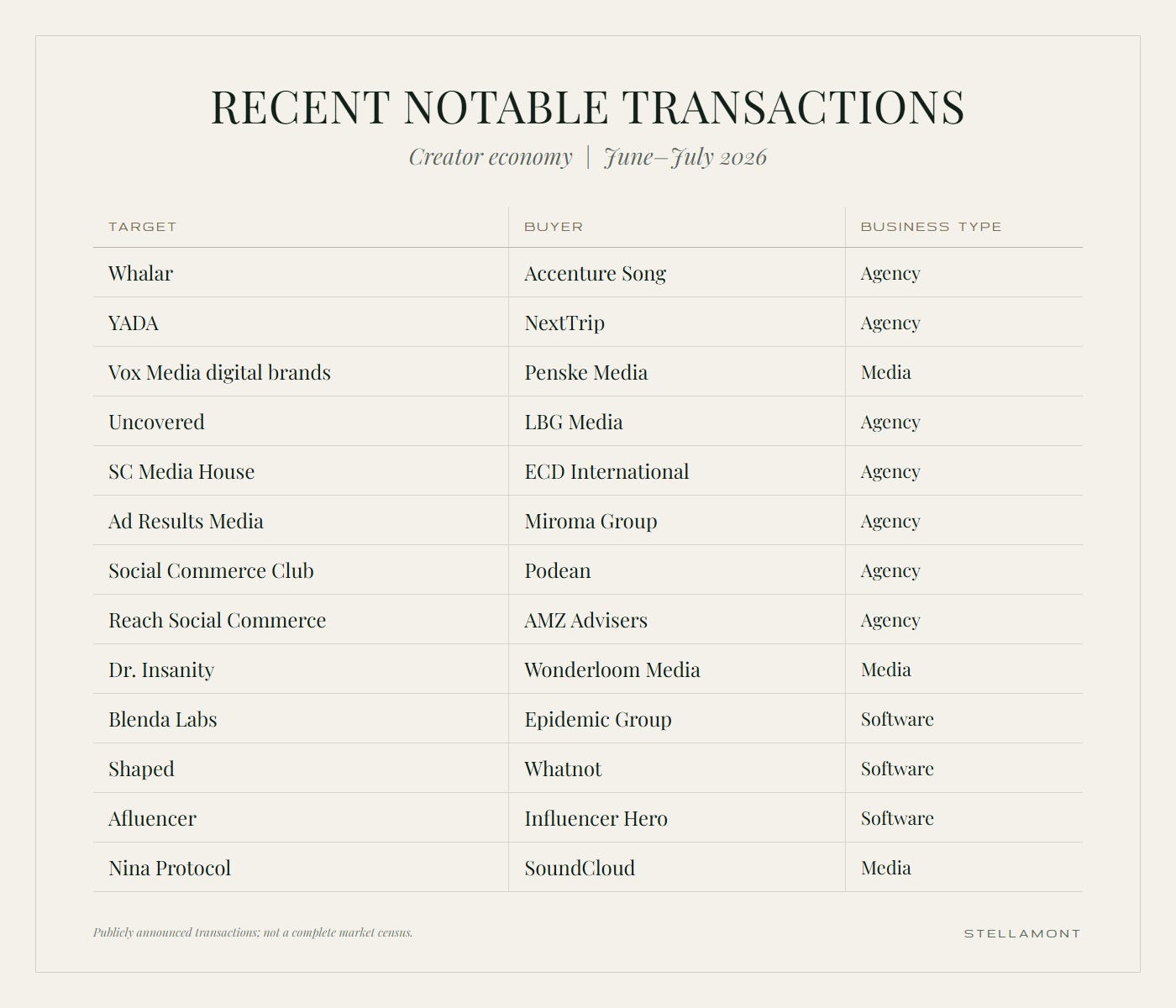
Accenture Song agreed to acquire Whalar, adding a scaled creator and social agency to its customer-growth platform.
NextTrip acquired a controlling interest in YADA, adding a TikTok commerce agency to its creator, entertainment, and travel-commerce ecosystem.
Penske Media acquired Vox Media’s digital brands, including The Verge, Eater, SB Nation, Popsugar, and The Dodo.
LBG Media acquired 75% of Uncovered, bringing a Gen Z-focused social-first creative agency into its media platform.
ECD International acquired a majority stake in SC Media House, adding an influencer-marketing agency to its broader services platform.
Miroma Group took a majority stake in Ad Results Media, combining creator, audio, podcast, and performance media capabilities.
Podean acquired Social Commerce Club, expanding its TikTok Shop and social-commerce infrastructure.
AMZ Advisers acquired Reach Social Commerce, moving from Amazon growth services into TikTok Shop.
Wonderloom Media launched with the acquisition of Dr. Insanity, treating a YouTube-native business as scalable media IP.
Epidemic Group acquired Blenda Labs, adding AI-native video production capabilities to a music and sound platform.
Whatnot acquired Shaped, strengthening real-time discovery and personalization for live commerce.
Influencer Hero acquired Afluencer, combining campaign-management software with a creator marketplace.
SoundCloud acquired Nina Protocol, adding an independent-artist community, editorial archive, and discovery assets.
These are not identical transactions. Some add brand-facing agency capabilities. Some consolidate scaled audiences and media IP. Others add software, commerce, or production infrastructure.
The common thread is that buyers are acquiring strategic capabilities and operating systems, not simply lists of creators.
The distinction buyers are making
In a recent conversation with a large agency platform, the buyer described its acquisition strategy as an effort to build a more integrated agency. The focus was on sports, creators, experiential work, branded content, partnerships, and social activation: services that can be sold directly to brands and integrated into a broader client offering.
That is different from pure talent representation.
A representation business primarily earns commissions from contracts between talent and brands. It can be an excellent business, especially when the roster is differentiated and the relationships are durable. But a buyer evaluating an agency platform will ask a different set of questions:
Does the company own the client relationship, or only the talent relationship?
Can the service be sold repeatedly to brands without relying on one-off introductions?
Is revenue generated from repeatable agency services, or mostly commissions passed through to talent?
Can the team execute campaigns across creators, athletes, media, experiential, and content?
Does the business add capability to an existing platform, or require the buyer to rebuild the model?
This is why some buyers are actively looking for agency-like businesses. An agency can be integrated into an existing sales machine, introduced to more brands, and scaled through shared creative, media, strategy, data, and production resources.
How a pure representation business becomes more sellable
The answer is not to stop representing talent. The answer is to build layers around the representation model.
1. Own a clear commercial niche
“We represent creators” is not a strong enough position by itself.
A more valuable business might own a defined intersection such as sports creators and betting brands, beauty creators and commerce, gaming and live events, or music creators and direct-to-fan monetization.
The narrower the commercial problem, the easier it is to explain why a buyer needs the business.
2. Build brand-direct revenue
Track the percentage of revenue that comes directly from brands, agencies, platforms, and recurring accounts. Separate it from pass-through talent economics.
Buyers want to understand net revenue, contribution margin, client concentration, renewal behavior, and the amount of work required to generate each dollar. Gross billings can look impressive while obscuring the actual economics of the business.
3. Turn relationships into repeatable services
Project work is useful, but repeatable services create more strategic value.
Examples include creator campaign management, brand partnership strategy, content production, experiential activation, social commerce execution, measurement, and ongoing account management.
The goal is to make the company useful even when a particular creator is unavailable.
4. Make the roster durable
Exclusivity helps, but it is not the only measure of roster quality. Buyers will look at contract duration, renewal history, revenue concentration, creator retention, audience quality, and whether the business can add new talent without losing its identity.
A roster should be an asset supported by systems, not a spreadsheet held together by personal relationships.
5. Institutionalize the operating system
Document how the company sources talent, prices campaigns, manages brand relationships, approves creative, tracks deliverables, collects cash, and reports performance.
The more the business depends on the founder’s memory, network, and personal ability to close every deal, the more the buyer is acquiring a job.
The more the company has repeatable processes, trained account owners, clean data, and visible pipeline, the more it resembles an asset.
Sources
Recent transaction announcements and public disclosures referenced in this article:
Accenture Song — Accenture to Acquire Leading Creator and Social Agency Whalar from Whalar Group
NextTrip — Form 8-K: Acquisition of Controlling Interest in YADA
Penske Media — Penske Media Corporation Acquires Vox Media Brands
LBG Media — LBG Media Acquires 75% of Uncovered
ECD International / Clairfield — Majority Investment in SC Media House
Miroma Group — Miroma Group Acquires Majority Stake in Ad Results Media
Podean — Podean Acquires Social Commerce Club
AMZ Advisers — AMZ Advisers Acquires Reach Social Commerce
Wonderloom Media — Wonderloom Media Launches with Acquisition of Dr. Insanity
Epidemic Group — Epidemic Group Acquires Blenda Labs
Whatnot — Whatnot Acquires Shaped
Influencer Hero — Afluencer Joins Influencer Hero
SoundCloud — SoundCloud Acquires Nina Protocol
All transaction descriptions are based on publicly available company announcements, SEC filings, and press releases. Stellamont M&A is not advising on these transactions unless expressly stated.
✦ Talk to Stellamont
Thinking about selling your agency, talent management firm, creator business, or media company? We advise founders on valuation, transaction preparation, and competitive sell-side processes across the creator economy.
the image gives the business idea a scene people can picture.
Community distribution sales and repeat business