

The most expensive mistakes in a business sale happen before any document is signed. They happen in the first call with a buyer. A founder answers a question they didn’t need to answer. Reveals a number they shouldn’t have named yet. Enters a bilateral conversation without knowing the other side has run this exact process dozens of times.
Here is what that process looks like from the other side of the table, and what it costs to learn it during the deal rather than before it.
The deal starts before you know it’s happening.
When a strategic acquirer reaches out, they are already running a process. You are not. They want to learn how much you want to sell, whether you have other options, and how low the number can go. Every question in that early call is intelligence-gathering. Every answer is leverage you’ve surrendered before the negotiation has officially begun.
The side that wants the deal more loses. Professional buyers know this. They are trained to reveal as little desire as possible while drawing out as much as they can from the seller. Most founders walk into that dynamic without knowing it exists. By the time an advisor is brought in, the founder has already shared their ARR, explained their margins, disclosed why they’re open to a sale, and implicitly confirmed there’s no competition. The leverage is gone before the first offer arrives.
Price is a function of competition, not business value.
This is the most important thing to understand before entering any sale process. Your business has real value. But the price a buyer offers reflects how many other buyers they believe are in the room far more than it reflects the underlying business. A buyer negotiating with no competition offers what the model supports and nothing more. A buyer who believes they are competing against four credible acquirers offers what they need to win.
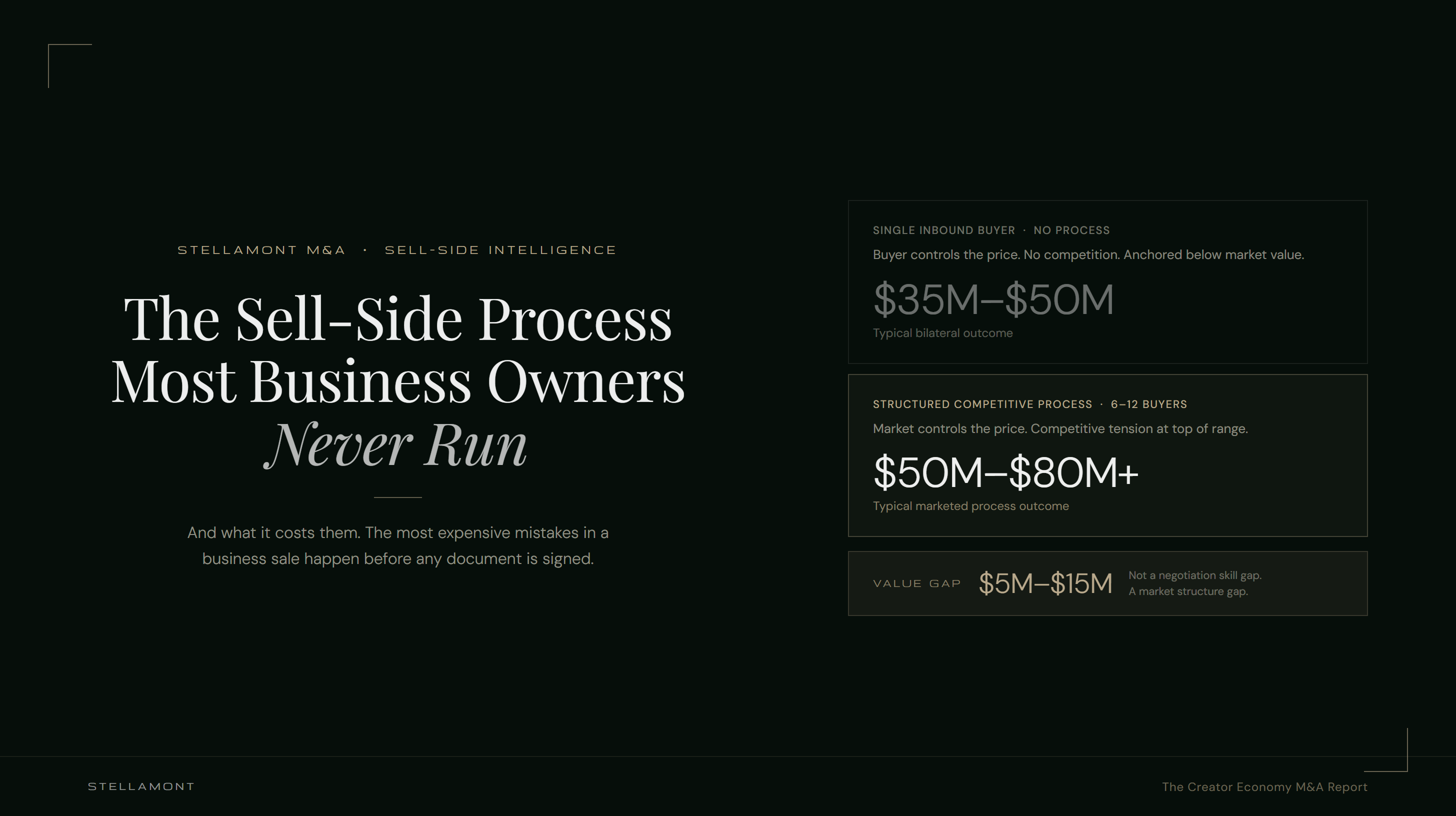
Here is what each scenario typically produces on a $10M ARR business:
Single inbound buyer, no process — The buyer controls the price. Anchored below market.
Structured competitive process, 6 to 12 buyers — The market controls the price. Competitive tension at top of range.
On a $10 million ARR business, the spread between a bilateral conversation and a structured competitive process is routinely $5 to $15 million. That is not a negotiation skill gap. That is a market structure gap. You cannot close it by being a better negotiator. You close it by running a different kind of sale.
The acquisition universe is almost always too small.
Most business owners come into a sale with a short list of obvious buyers. One or two strategics they’ve heard mentioned. Maybe a PE firm that reached out. The instinct is to focus on the most likely buyer and protect the relationship. That instinct is expensive.
Effective sell-side processes expand the buyer universe aggressively, including buyers who may seem like secondary fits. Not every participant is expected to close. Some are in the process to create pressure. In at least a quarter of the competitive processes we run, buyers with no realistic chance of closing force the eventual acquirer to pay more than they otherwise would have. That is not a coincidence. It is the design.
The right buyer universe sits between six and fifteen participants. Below six, there isn’t enough competitive pressure. Above fifteen, the process becomes cumbersome. High single digits, run simultaneously, is where the math consistently works in the seller’s favor.
A bidding process is not complicated. It is just rarely used.
Most sellers assume a structured competitive process means months of complexity and friction. The mechanics are simpler than that.
No asking price goes to market. Buyers have to bid to find the floor. Bids are closed: no buyer sees what anyone else offered. Rounds run simultaneously. Round one bids are due Thursday at 5 PM. All of them. Not one this week and one the next. All of them at the same time. Then the seller reviews the offers side by side and asks everyone still in the room to sharpen their number.
That is the structure. It exists because ninety percent of progress in any negotiation happens in the last ten percent of time. Imposed deadlines compress that into the seller’s timeline, not the buyer’s. A buyer chasing a deadline they didn’t set is a buyer who can’t control the pace. That is exactly where a seller wants them.
Founders who negotiate their own sales give up the result before it starts.
This is not a question of intelligence or preparation. Business owners are structurally disadvantaged when negotiating their own sales for reasons that have nothing to do with capability.
Your identity is tied to the business. Your employees are on the line. The number being discussed is the largest check you have ever seen. And the person across from you has done this exact deal 20 to 40 times. They are trained to read when a seller is nervous, when they’d take the lower number, when the walk-away is a bluff. They see it before you know you’re projecting it.
The value of a dedicated sell-side advisor is not just buyer access. It is the insulation between the seller and that exposure. The advisor takes the heat. Makes the difficult asks. Has the uncomfortable conversations. And because the advisor is not the decision-maker, they can say “I’ll bring that back to my client.” Buyers use that phrase against sellers every single day. It is far more powerful when the seller’s team says it first.
"The price you walk away with is not a reflection of your business's value. It is a reflection of how many buyers had to compete to get it. Those two numbers are often far apart."
The right time to think about this.
If you are fielding inbound interest or beginning to think seriously about a sale in the next one to two years, the most useful conversation you can have right now is not with the buyer who called. It is with someone who already knows which companies are actively acquiring in your space, what they paid in the last 12 months, and how your business sits against their criteria.
The founders who get the best outcomes are not the ones who waited for the right offer. They are the ones who understood the market before any buyer knew they were thinking about it. That knowledge changes what you say, what you don’t say, and how the process gets structured when the time comes.
A 30-minute conversation, under NDA, at no cost, is enough to tell you whether the timing and the value are there. That is where this starts.
✦ Talk to Stellamont
If you’re considering a sale or fielding acquisition interest, we’ll give you an honest read on value, the active buyer landscape in your space, and what a competitive process would actually look like for your business. No cost, no commitment.