

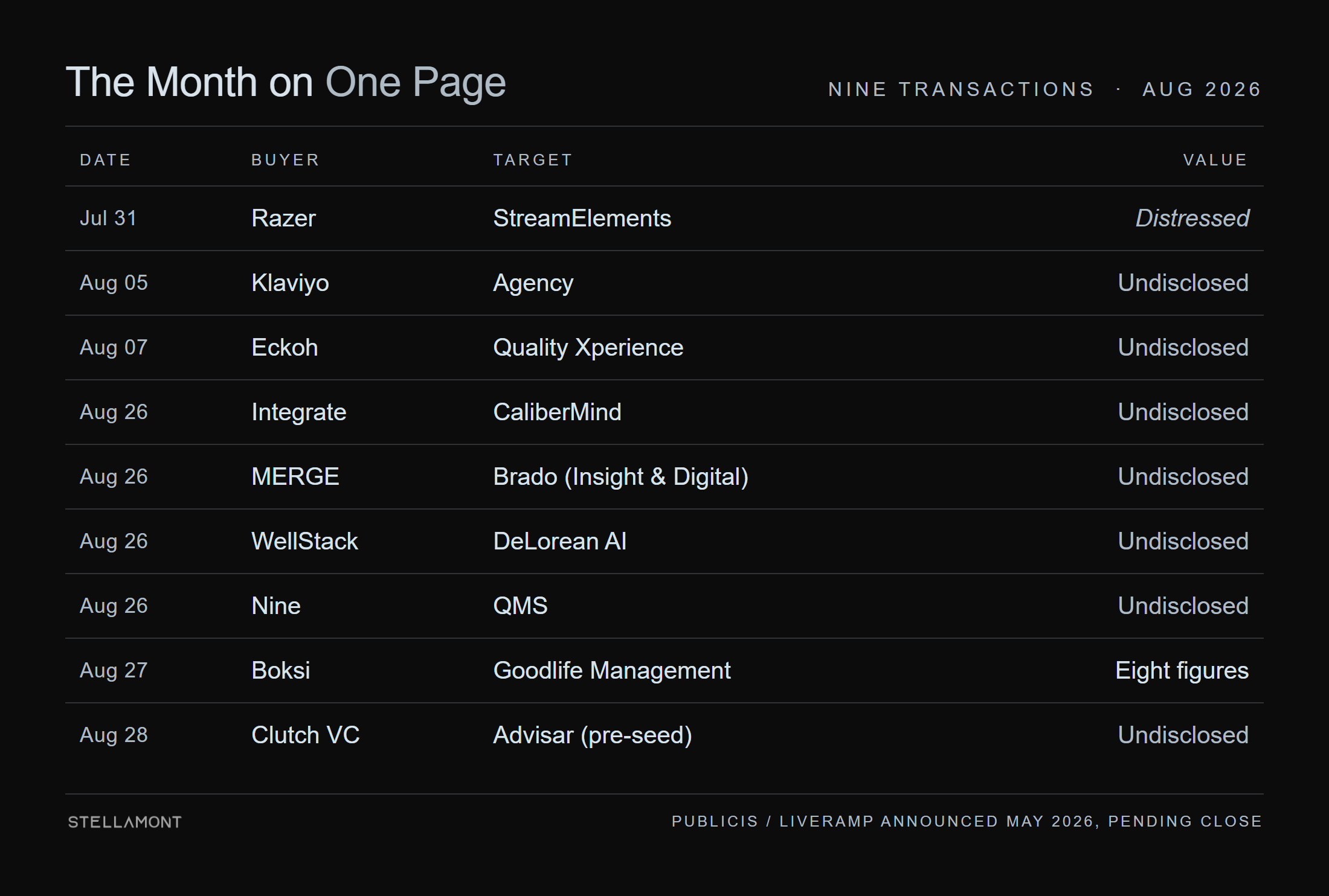
The month on one page. Nine transactions, all announced inside the last 30 days. The Publicis/LiveRamp deal below was announced in May and is still awaiting close, so it sits outside this table.
Three weeks ago we argued that creator marketing was becoming performance infrastructure. That budgets were moving from brand awareness to measurable customer acquisition, and that buyers would follow.
August made the same case from the other direction.
Almost none of the notable deals were creator deals. They were martech deals. And nearly every one was a buyer paying for the ability to measure something.
Start with the story that has been running all summer.
Publicis bought the neutral party. In August the bill came due.
Back in May, Publicis Groupe agreed to acquire LiveRamp at an enterprise value of $2.167 billion, paying $38.50 a share, a 29.8% premium to the last close before the announcement. The deal has not closed yet. It is expected to complete before year end, subject to regulatory and shareholder approval.
So the deal is not the August news. The August news is what the deal did to LiveRamp’s customer base while everyone waited for it to close.
LiveRamp was the connective tissue that let competing agencies, brands and platforms move identity and data across each other’s walled gardens. No other company in adtech held that position. Neutrality was not a feature of the product. It was the product.
Publicis CEO Arthur Sadoun called the deal a nonevent for clients. LiveRamp technology, he said, is neutral by design.
The market disagreed within days. Omnicom accelerated its exit from the platform. WPP stopped using it. Both said the same thing. They will not run their identity layer on infrastructure owned by a direct competitor. Both are now building their own.
Sadoun’s claim was about code. The customers’ objection was about incentives. Roadmap, pricing and access get decided by the parent company, and the parent company competes with the people paying for the service.
There is a lesson in that for owners, and it is not the obvious one.
If your business depends on sitting between rival parties, the strategic buyer offering the highest headline number may be the one who breaks what they bought. That is not a reason to refuse the deal. It is a reason to know it before you run a process, so you can price it, structure it, and judge whether a financial buyer or a neutral strategic is worth more to you net of the churn that follows.
The highest bid and the best outcome are not always the same document.
Source: AdExchanger
Buyers are paying for measurement, not media
Set LiveRamp aside and the deals actually announced this month tell one story.
Integrate acquired CaliberMind on August 26. Integrate runs lead management and data governance for B2B marketing teams. CaliberMind does multi-touch attribution, marketing mix modeling, account scoring and revenue intelligence. Terms were not disclosed. The stated goal is closing the loop between top-of-funnel activity and revenue outcomes, turning performance insight into immediate next-step activation.
That is demand generation buying its own scoreboard.
Source: MarTech
The same day, MERGE acquired Brado’s Insight and Digital practices. MERGE is a marketing and technology agency with more than 160 clients. It bought proprietary qualitative research and performance media, pointed at health, wellness and life sciences. The stated rationale was behavioral research combined with generative engine optimization.
Source: GlobeNewswire
Also in August, WellStack acquired DeLorean AI, and Eckoh acquired Quality Xperience to expand AI capability in customer experience.
Four deals, one pattern. In every case the target owned research, data or attribution. None were bought for reach.
Platforms are buying AI teams outright
On August 5, Klaviyo agreed to acquire Agency, a three-year-old AI customer success startup founded by Elias Torres. Terms were not disclosed, with close expected in Q3. Agency had raised $32 million from Sequoia, Menlo Ventures and Felicis. Its 25-person team joins Klaviyo, and Torres becomes chief product officer.
Torres previously co-founded Drift, which sold to Salesloft in 2023.
Note the shape of that deal. A public lifecycle marketing platform bought a 25-person company and installed the founder in the C-suite to run product. The team and the capability were the asset. Klaviyo is pointing it at two AI agents already in market, Composer for campaign build and Customer Agent for post-sale support.
If you run a small AI-native software company, that is the exit actually available right now, and it clears at a real price. It also requires a founder willing to go operate inside someone else’s company for several years. Not every owner wants that deal. It is worth deciding which you are before a banker puts you in front of one.
Source: Klaviyo
Retail and commerce media keeps pulling capital
Nine acquired QMS on August 26, adding digital signage software for out-of-home advertising. Advisar, a retail media platform founded by a Walmart veteran, raised pre-seed funding from Clutch VC in late August.
Retail media is where marketing budget goes when the CFO wants attribution. Two more entrants funded in a single week is not a coincidence. The M&A is following the budget.
The creator side is converging on the same test
Two firms made the argument explicitly this month.
Fohr founder James Nord told brands to treat creators like an investment portfolio. Billion Dollar Boy launched a product called Creator Investment Intelligence, on the finding that half of marketers misprice creator fees.
Both are saying creator spend should be underwritten, not budgeted. That is a martech idea applied to a creator problem.
The transactions match.
Boksi acquired Goodlife Management on August 27 in a reported eight-figure deal, described as the largest known acquisition in the German influencer market. Boksi is a Helsinki-based creator marketing platform. Goodlife is a German talent agency representing around 30 beauty and lifestyle creators, with brand relationships including L’Oréal and LVMH. Founder Armin Danesh stays on as Managing Director and becomes a shareholder in Boksi’s parent company. It is Boksi’s third German acquisition in three years.
Note the direction of that one. The software company bought the services company. The roster became distribution for the platform, not the other way around. Note the structure too. The founder rolled equity into the acquirer rather than taking all cash and leaving, which is what a buyer asks for when the relationships still matter.
Source: ArcticStartup
And the counterexample worth studying
On July 31, Razer acquired StreamElements. Terms were not disclosed, but this was a rescue.
StreamElements had been through several rounds of layoffs. Its founder had publicly asked users to donate to keep the service running. By May a shutdown looked imminent. The company sought a buyer to avoid collapse, and the acquisition is believed to have closed well below the roughly $111 million it had raised over its life. Razer bought the assets.
2.6 million creators used StreamElements daily. It was not enough.
That is enormous reach, and it was not enough.
Scale of usage is not enterprise value. A business can sit at the center of millions of creator workflows and still fail to convert that position into revenue a buyer will underwrite. When it does not, reach becomes a cost line, not an asset, and the outcome is an asset sale below invested capital.
This is the most useful transaction of the month for founders, precisely because it went badly.
Source: Tubefilter
What this means if you own one of these businesses
The diligence question has converged. It is now the same question in martech and in the creator economy.
It is no longer how large your audience is, which brands you serve, or which creators you represent. It is three things.
Can your revenue be attributed? Can a buyer trace what your business produced, inside their own system, without taking your word for it?
Does it recur? Project revenue and campaign revenue get discounted hard. Contracted, renewing, embedded revenue does not.
Does it survive you? If the relationships, the judgment and the selling all live with the founder, the buyer is not acquiring a company. They are hiring a person and paying goodwill for the privilege.
That is a harder test than most owners expect. It is also the fairer one, and it is the test that sets the multiple.
Businesses that pass own something. Proprietary data. Embedded customers. Attribution the buyer can verify. Workflow the client cannot easily rip out.
Businesses that fail sell access. Every strategic buyer already has access in house.
If you are two or three years out from a process, the work starts now, and it does not start with a banker. It starts with the parts of the business a buyer will underwrite.
If you want a candid read on where yours sits today, reply to this email. We will tell you straight, including when the answer is not yet.
Stellamont is a sell-side M&A advisory firm for founder-owned businesses in marketing infrastructure, software and SaaS, tech-enabled services, and the creator economy. We represent sellers exclusively, never buyers. stellamont.com