

Hope everyone is enjoying the Labor Day long weekend. Here is what moved while the market was heading out of town.
The two weeks on one page. Widening the window this issue, because the deals cluster either side of the month end.
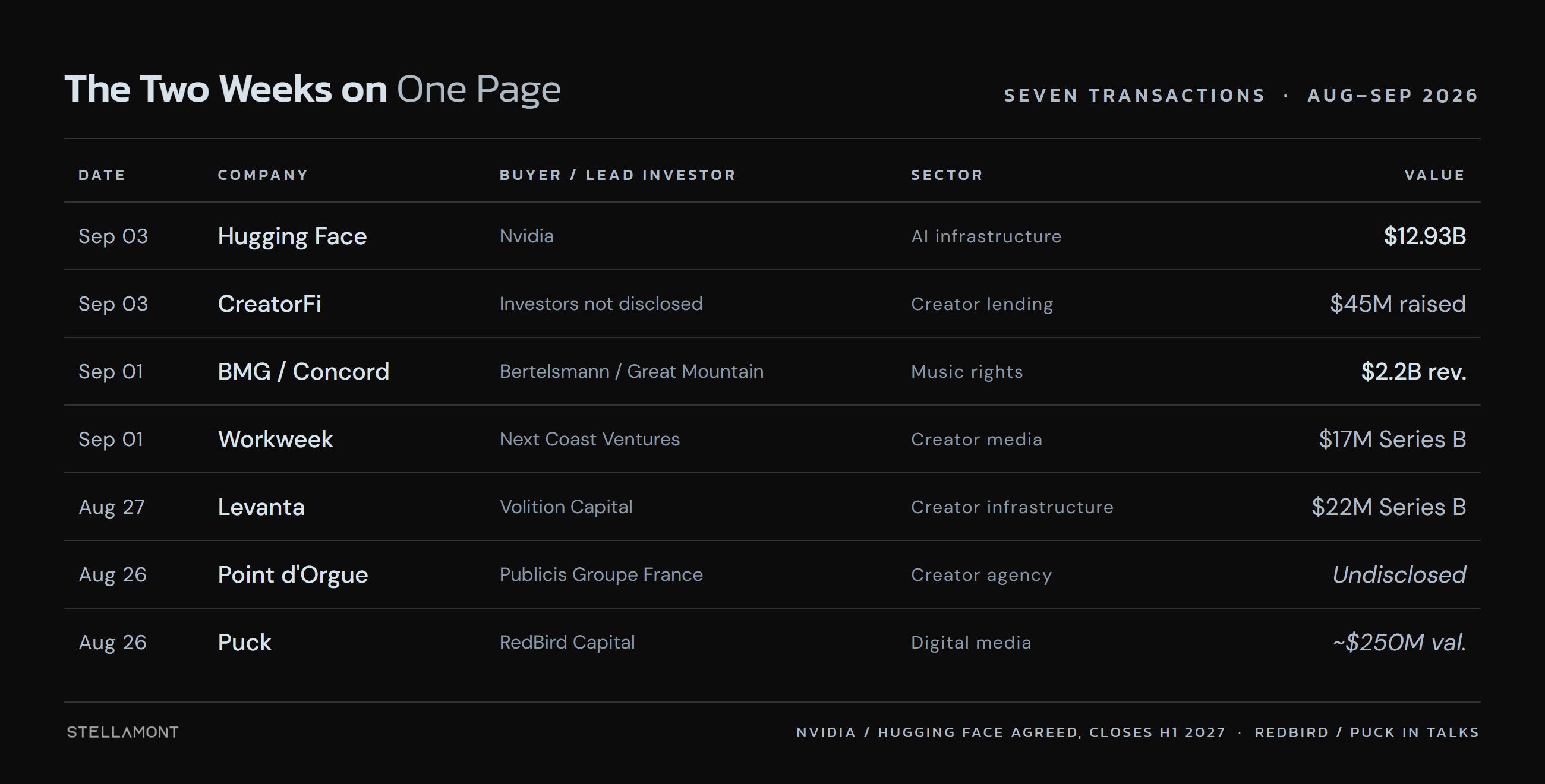
Seven transactions. The biggest number belongs to the deal furthest from this newsletter’s beat. The most instructive one is the deal nobody put a number on at all.
Publicis bought an influence agency and folded it the same day
On August 26, Publicis Groupe France acquired Point d’Orgue, a Paris influence marketing agency founded in 2016 by Carine Fernandez. About forty staff. Roughly forty exclusive creators. Strong specialization in luxury and beauty. Terms were not disclosed.
The agency goes straight into Influential France, the influence unit Publicis recently launched in the French market under Paul Boulangé. Fernandez continues to lead it inside the group.
If you own a creator or influence agency, this is the most important transaction of the two weeks, and it is worth sitting with what actually happened.
A good agency, ten years old, with exclusive talent relationships and a defensible niche, sold for a price nobody involved wanted to print. It was absorbed into a platform the buyer already owned, on the day the deal was announced.
That is not a criticism of the business or of the outcome. Founders sell for all kinds of good reasons, and a home inside Publicis is a real one. But notice the shape of it. Publicis was not buying a company to run. It was buying capability to install.
Capability gets priced on what it earns. Undisclosed usually means a number that would not flatter anyone in print.
Source: Publicis Groupe France
The same two weeks, the money went somewhere else entirely
Two creator businesses raised money in the same two weeks, and neither of them sells campaigns.
Levanta raised $22 million in a Series B led by Volition Capital on August 27, the firm’s second investment after leading the $20 million Series A in 2024. Total funding now past $43 million. The headline on Levanta’s own release reads “to Deploy the Infrastructure for Creator Commerce Media.”
What Levanta does is unglamorous and valuable. Brands find creators, send product, set affiliate commissions, track the sale and handle payment. More than 90,000 vetted creators on the platform, revenue up 80% year over year in 2026, expanded from Amazon affiliate roots into Walmart, Shopify and other marketplaces.
That is a closed loop from creator post to tracked, paid transaction.
CreatorFi raised $45 million to advance capital against creator and studio revenue. Checks run from $500,000 to $5 million. In exchange the firm takes a share of platform revenue, typically around 50%, and requires the creator to produce new intellectual property on a schedule. Its portfolio includes the music label Coasthill IV, the game developer Mythical Games, and individual creators.
Strip away the creator framing and this is a specialty lender underwriting cash flows.
Which raises the question every owner should sit with. You can only underwrite what you can measure. CreatorFi is not advancing money against a follower count. It is advancing against observable, recurring platform revenue with a contractual obligation to keep producing the asset that generates it.
A capital provider has arrived at the same test a strategic acquirer applies. When lenders and buyers converge on one test, that test is the market.
Separately, Workweek raised $17 million in a Series B led by Next Coast Ventures on September 1, bringing total funding to $36.5 million, for a B2B creator media business.
Sources: Levanta, GeekWire, EQS News
Later showed what that looks like once it works
On September 1, Later announced it has paid creators more than $300 million cumulatively, with revenue more than doubling over two years and growing 50% in the last twelve months. In the same move, Mavely stopped operating as a separate brand and became Later.
That is the closing chapter of a deal, not a new one. Later acquired Mavely in January 2025 for $250 million. One year in, the combined business reported a $2.4 billion annual GMV run rate and $250 million in cumulative creator payouts. Now the brand is folded and the number is past $300 million.
Note which figure Later chose to lead with. Not followers reached. Not campaigns run. Dollars paid out. It is the one number that cannot be inflated, and it doubles as evidence that the attribution works.
An influencer platform that reports reach is selling a metric the buyer already distrusts. A platform that reports attributed revenue is selling proof.
Set that beside the Publicis deal. Later paid $250 million for the company that closed its loop. Publicis paid an undisclosed sum for forty people. Both were rational. They were not buying the same kind of asset.
Source: PR Newswire
X took its own payment rail, and nobody could stop it
On September 2, X moved all US creator payouts off Stripe and onto X Money, its own payments service. The change covers income from both the Original Content Rewards Program and creator subscriptions. Creators outside the US stay on Stripe for now.
The stated benefit is real. X Money removes the bi-weekly processing cycle and the $30 minimum threshold. Payouts are instant.
The same week, X confirmed that its older Creator Revenue Sharing Program, which stopped accepting new participants in August, retires on September 7. Those creators migrate to Original Content Rewards.
So in a single week a platform changed who processes its creators’ money, and changed which program governs how that money is earned. No creator was consulted. No creator could opt out.
Payment processing is not a feature. It is a data position. Whoever moves the money sees every transaction, every cadence, every dollar earned per creator per format. X did not just cut a vendor. It repatriated the highest-resolution dataset in its own economy.
Source: TechCrunch
YouTube rewrote monetization by the second
On September 4, YouTube published new rules for graphic violence in gaming content, ahead of the November 19 release of GTA 6. The framework is now measured in seconds. Graphic content in the first seven seconds of a video disqualifies it from ad revenue entirely. Content appearing from the eighth second onward can run standard ads.
An entire content category’s economics now turn on where an editor places a cut.
The point is not whether the rule is reasonable. It probably is. The point is that a creator business built on that platform had its unit economics rewritten by an announcement it did not see coming and cannot appeal.
Source: YouTube Help
The same logic, at a scale none of us will play in
Two data points from the top of the market, because they price the principle the rest of this issue is describing.
On September 3, Nvidia confirmed it will acquire Hugging Face for $12.93 billion, its second largest deal on record. Agreed, not closed; completion is expected in the first half of 2027 subject to regulatory approval. Hugging Face has more than 18 million developers, more than 3 million models, and 200,000 enterprise customers. It does not produce models. It is where models are found, hosted and pulled from.
Nvidia already sold the compute. What it did not own was the layer where every developer decides which model to run on that compute.
And on August 31, OpenAI announced ChatGPT Ads had reached a $1 billion annualized run rate in under 200 days. In these two weeks it expanded across 31 European countries plus India and MENA, with self-service now listed in 52 markets, alongside custom audiences, conversion measurement, campaign pacing and product-level reporting through an Insights API. That is a demand-side platform, built in under seven months.
Neither deal is creator economy. Both price the same thing your buyers are pricing: the layer everyone else has to route through.
Sources: CNBC, Search Engine Land
Meanwhile, the tenants signed longer leases
Three of the biggest names in media and retail spent the same two weeks committing harder to infrastructure they do not own.
On September 2, the NFL renewed its TikTok partnership in a new multi-year agreement. The interesting part is not the highlights. It is that Pulse Premiere, TikTok’s product for placing ads alongside official content, now extends past the main @nfl account down to individual member clubs. The deal also puts NFL hubs inside TikTok GamePlan and adds a fan rewards product called TikTok Pro Events. Terms were not disclosed.
The most valuable rights holder in American sport just routed more of its advertising surface through a platform’s ad stack rather than its own.
The same day, Sephora announced a TikTok Shop pilot, its Sephora Drop Shop, launching September 19. Monthly exclusive drops, creator-led content, culminating in a TikTok LIVE with a celebrity host. Worth being precise, because most coverage was not: Sephora has not launched. It has announced a pilot that begins on the 19th.
Then the exception. Google signed MrBeast to a multi-year partnership spanning Gemini, Google Health and Fitbit, with the first video landing September 5. Google framed the deal around his being the first individual creator past 500 million YouTube subscribers.
Notice the direction of payment. Everywhere else the platform took something. Here the platform is paying, because 500 million subscribers is the one asset Google cannot build, buy cheaply, or replicate with a product update.
That is what leverage looks like on the creator side, and it is vanishingly rare.
Sources: Sports Video Group, Sephora Newsroom, Google
Two more worth watching
BMG and Concord closed their merger on September 1, announced back on April 28, creating a company with roughly $2.2 billion in pro forma annual revenue and $730 million in adjusted operating EBITDA for 2026. Bertelsmann holds about 67%, with affiliates of Great Mountain Partners at roughly 33% after a one-time cash payment of $1.16 billion. Music publishing and recorded rights are the purest version of the asset this newsletter keeps describing: owned, cataloged, contractually durable.
RedBird Capital is in advanced talks to invest in Puck at around a $250 million valuation, reported August 26. The structure is the interesting part. It would be all cash, buying out institutional holders including TPG, and would not include shares held by Puck’s founders and journalists. Puck has roughly 50,000 paying subscribers. Nothing is signed.
Sources: Bertelsmann, Axios
What this means if you own one of these businesses
Put the two weeks in one line. A ten-year-old creator agency with exclusive talent sold for a price nobody printed. Levanta, which owns the attribution layer, raised $22 million at a valuation it was happy to publicize, from an investor backing it for the second time.
That gap is not about quality. Point d’Orgue is, by every account, a good agency. The gap is about what each business owns when the buyer runs diligence.
There is a harder lesson underneath, about dependency. Two platforms in these two weeks unilaterally changed how creators get paid and how much they earn per video. Any business whose economics sit downstream of a decision like that is a tenant, and tenants trade at tenant multiples.
MrBeast was the only party who negotiated from the other side of that table, and he did it with an audience no platform can reproduce. Note that the NFL has enormous leverage over rights and still routed its inventory into someone else’s ad stack. Leverage over content is not the same as leverage over the rail.
So the diligence question has not changed. It has only gotten sharper.
Can your revenue be attributed? Not described. Traced, inside a buyer’s own system, without taking your word for it.
Does it recur? Campaign and project revenue gets discounted hard. Contracted, renewing, embedded revenue does not.
Does it survive a rule change? If a single platform policy update can reprice your business, a buyer will price that risk before you finish the pitch.
Businesses that pass own something. Data, attribution, contracts, workflow the client cannot easily remove. Businesses that fail sell access to a platform they do not control, and every strategic buyer already has that access in house.
If you want a candid read on where yours sits today, reply to this email. We will tell you straight, including when the answer is not yet.
Stellamont is a sell-side M&A advisory firm for founder-owned businesses in marketing infrastructure, software and SaaS, tech-enabled services, and the creator economy. We represent sellers exclusively, never buyers. stellamont.com